
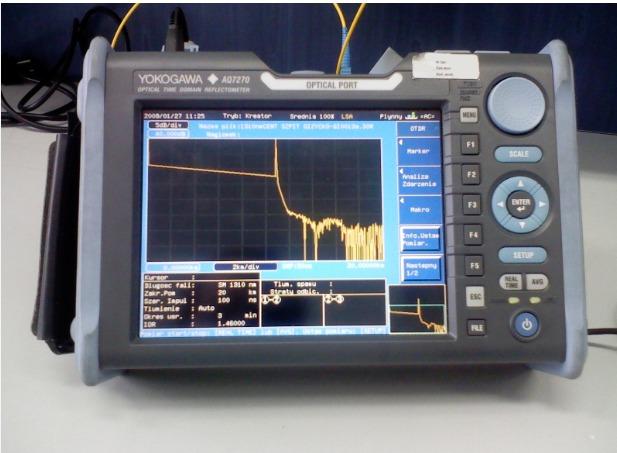
OTDR is a testing instrument used to check the performance and health of fiber optic cables.
It works by sending a light pulse through the fiber and then measuring the light reflected back.
•This data helps to:
§Identify any breaks, bends, or faults in the fiber.
§Measure the signal loss (attenuation) across the length of the fiber.
§Calculate the total length of the fiber.
🔹 Where is OTDR used?
•Telecom networks (fiber optic installation, maintenance & fault detection)
•FTTH (Fiber to the Home) projects
•Railway signaling systems, Power transmission, and Internet Service Providers (ISPs).
•Used in long-distance optical fiber network monitoring.
🔹 Key Features
•Distance Measurement – How far the fiber runs.
•Loss Measurement – How much signal is lost over the length.
•Fault Location – Pinpoint the exact location of a fault, break, or bend.
•Graphical Trace Report – Provides a visual representation of the fiber’s health.
🔹 Types of OTDR
•Handheld OTDR – Compact, for field engineers.
•Benchtop OTDR – For laboratory or fixed setups.
•Smartphone-based OTDR – Controlled via app, very compact